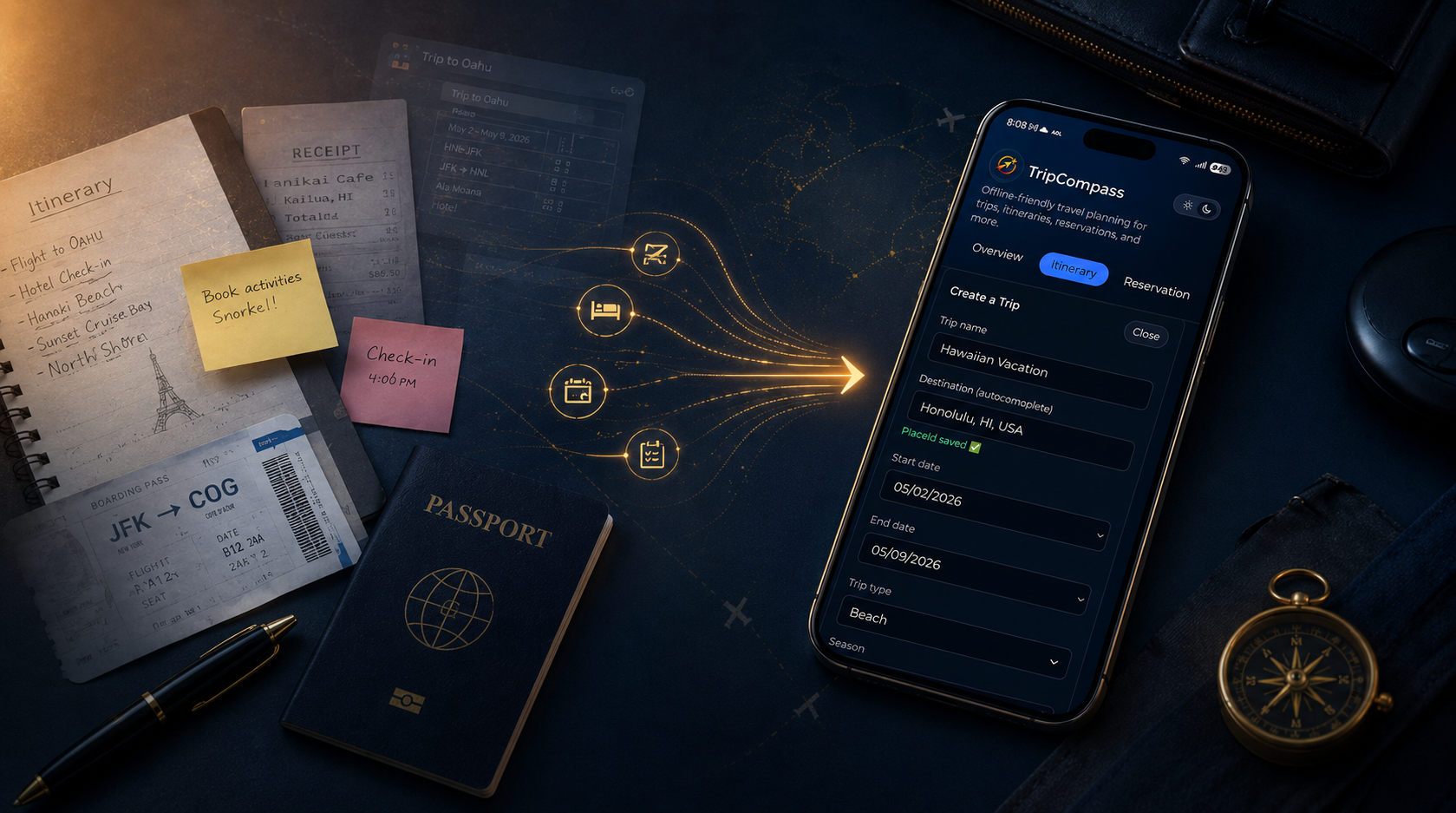
Travel planning can start out fun, then quickly turn into a mess of confirmation emails, screenshots, notes, spreadsheets, booking numbers, hotel addresses, packing reminders, and “where did I put that?” moments.
One minute you are excited about the trip. The next, you are searching your inbox at the airport gate, scrolling through old messages, or trying to remember whether the hotel check-in time was in an email, a text, or a note on your phone.
The good news: organizing a trip does not have to feel like managing a tiny travel office from your backpack.
Here is a simple way to keep your trip plans organized without relying on spreadsheets, scattered notes, or endless email searches.
Start with one place for the whole trip
The biggest mistake travelers make is spreading trip details across too many places.
Your flight confirmation is in email.
Your hotel address is in a screenshot.
Your restaurant idea is in a text thread.
Your packing list is in a notes app.
Your budget is in a spreadsheet.
Your activity reservation is buried somewhere you swear you saved.
That works until the trip actually starts.
Instead, create one central place for the entire trip. This should include the main trip dates, destination, reservations, itinerary, budget, packing list, and any important notes you may need later.
The goal is simple: when you need something, you know exactly where to look.
Break the trip into days or segments
A trip becomes easier to manage when it is divided into smaller pieces.
For a weekend getaway, that might mean Friday, Saturday, and Sunday.
For a longer trip, it might mean each city or major stop. For example:
New York
Paris
Rome
Cruise departure day
Beach resort stay
Return travel day
This makes your itinerary easier to understand at a glance. It also helps you avoid mixing up hotel nights, transportation times, and activities across different parts of the trip.
Instead of one giant pile of information, you get a clean travel timeline.
Keep reservations separate from ideas
There is a big difference between something you booked and something you might do.
Booked items should be easy to find and clearly marked. Flights, hotels, cruises, trains, rental cars, tours, and restaurant reservations should not be mixed in with “maybe” ideas.
A good system separates:
Confirmed reservations
Possible activities
Places to eat
Things to pack
Budget items
Important notes
That way, when you are standing at a check-in desk or boarding gate, you are not digging through a list of vacation ideas just to find a confirmation number.
Save the details you actually need
You do not need to save every tiny detail, but you do want the information that matters when you are traveling.
For flights, keep the airline, route, date, time, and confirmation number.
For hotels, keep the address, check-in and check-out dates, confirmation number, and any notes about parking, resort fees, or arrival instructions.
For activities, keep the date, time, meeting location, booking provider, and any special instructions.
For restaurants, keep the reservation time, address, and phone number.
These details seem small at home, but they become very important when you are tired, offline, rushing, or in a different time zone.
Build a packing list around the trip, not a generic checklist
A packing list should match the trip you are actually taking.
A beach trip, ski trip, cruise, hiking trip, city weekend, and international vacation all need different items. A useful packing list should reflect the destination, weather, length of trip, and activities planned.
At minimum, organize packing into categories:
Clothing
Toiletries
Documents
Electronics
Medications
Weather-specific items
Activity-specific items
Carry-on essentials
This keeps packing practical instead of chaotic. It also helps prevent that painful moment when you realize you packed five shirts but forgot the charger, swimsuit, passport, or medication.
Track your trip budget before the trip starts
A travel budget is much easier to manage when you start before you leave.
You do not need a complicated spreadsheet. You just need a clear place to track major costs like flights, hotels, rental cars, activities, meals, local transportation, parking, tips, and extras.
It helps to separate planned costs from actual expenses.
Planned costs show what the trip is expected to cost.
Actual expenses show what you really spent.
That simple separation gives you a much clearer picture of the trip without turning vacation planning into accounting homework.
Make sure your plans are available offline
This is one of the most overlooked parts of travel planning.
Internet access is not guaranteed. You may lose service at the airport, on a cruise ship, in another country, inside a hotel, on a train, or while walking around a new city.
That is why offline access matters.
Your core trip details should still be available even when the signal disappears. Flights, hotel information, itinerary notes, packing lists, and important reservation details should not depend entirely on Wi-Fi or mobile data.
The best travel plan is the one you can still open when your phone has no signal.
Keep it simple enough to actually use
The perfect travel planning system is not the one with the most features. It is the one you will actually use.
If your system is too complicated, you will abandon it. If it takes too long to update, you will go back to screenshots and scattered notes.
A good travel planning setup should be simple, clear, and fast. You should be able to add a reservation, check your itinerary, review your packing list, or look up a hotel address without thinking too hard.
Travel already has enough moving parts. Your planning system should reduce the noise, not add more.
A better way to plan with TripCompass
TripCompass was built for travelers who want their trip information in one place without juggling spreadsheets, email searches, or scattered notes.
With TripCompass, you can organize your trip itinerary, reservations, budgets, packing lists, and trip details in a simple mobile app designed for real-world travel. It works offline, does not require an account, and helps keep your plans accessible before and during your trip.
Whether you are planning a weekend getaway, family vacation, cruise, road trip, international adventure, or multi-city itinerary, the goal is the same: less time hunting for information, more time enjoying the trip.
Final thought
Travel planning should make the trip feel calmer, not more complicated.
If your current system depends on five apps, a spreadsheet, old emails, screenshots, and memory, it may be time to simplify. Put the important details in one place, organize the trip by day or segment, keep reservations separate from ideas, and make sure your plans are available offline.
Your future traveling self will thank you.
Ready to plan your next trip in one place?
Download TripCompass for iOS and Android to keep your itinerary, reservations, budget, packing list, and trip details organized wherever you go.
Get the app from the Download page.